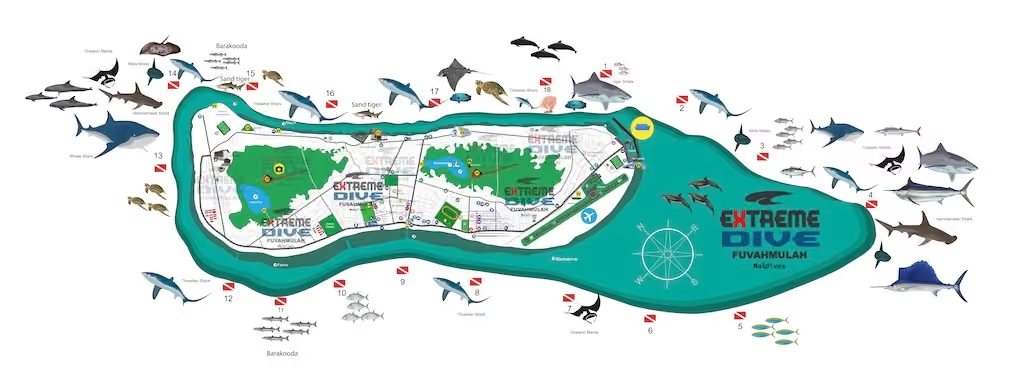








Explore 18 dive sites around Fuvahmulah, from colourful reefs and drift dives to encounters with ocean-going marine life. All dives are made by boat and led by our dive team. We choose each site according to your experience, the weather and current conditions.
Our usual programme includes three dives a day: one tiger shark dive and two reef dives. The boat normally returns to the harbour between dives. Typical departure times are 7:00 a.m., 9:30–10:00 a.m. and 12:00–1:00 p.m.; tiger shark diving is usually the second or third dive. Your guide confirms the daily schedule.
Fuvahmulah rises steeply from the deep Indian Ocean. Hard-coral reefs and dramatic drop-offs support a rich variety of reef fish and pelagic species. Wildlife sightings vary with conditions and are never guaranteed. Before each dive, your guide explains the site, planned depth, conditions and safety procedures.
Dive sites around Fuvahmulah
1. Tiger Shark Point (Neremathi)
2. Farimikede
3. Abadhas
4. Farikede (Fari Kede)
5. Ebithe Faro
6. Bilhifeyshi
7. Kalho Akirigando
8. Kandhoval
9. Maaneyre
10. Aruh Fanno
11. Nere Muli
12. Neregando Fanno
13. Gehmiskiy Fanno
14. Bahthi Dhoro
15. Havihtha Fanno
16. Ambul
17. Rasge Fanno
18. Bondo Fanno
Tiger Shark Point (Neremathi) lies beside the harbour entrance. The reef begins at about 8–12 metres and slopes to 30 metres and deeper. Fish waste discarded outside the harbour since its construction in 2004 has attracted tiger sharks to the area. Other marine life may include silvertip reef sharks, giant trevallies, rainbow runners and snappers. Before entering the water, our guides explain shark behaviour, group positioning and the dive procedures. Shark numbers and sightings vary from day to day.
Fari Kede is a protected marine area extending from the southern tip of Fuvahmulah. Its reef begins at about 10–15 metres before dropping into deep ocean water. This drift dive is suitable for advanced divers, with the route chosen according to the current. Reef life includes barracudas, dogtooth and skipjack tuna, giant trevallies, groupers and snappers. Reef sharks, thresher sharks, tiger sharks and oceanic mantas have been observed here. Occasional sightings have also included mola mola, hammerhead sharks, whale sharks, oceanic whitetip sharks and humpback whales. Encounters are never guaranteed.
Hudhukede (Thoondu) is on the north-eastern corner of Fuvahmulah. The reef starts at about 6 metres and descends beyond 30 metres. Hard corals provide shelter for triggerfish, wrasses, surgeonfish and parrotfish. Hawksbill turtles, whitetip reef sharks and scorpionfish may be seen around the larger coral formations. Thresher sharks, oceanic mantas and whale sharks have also been observed when conditions allow. Your guide selects the route and depth according to the conditions and the group’s experience.
Maaneyre was used as a landing beach before the harbour was built. Its hard-coral reef begins at about 12 metres and slopes towards deep ocean water. Colourful reef fish gather along the reef, while currents bring nutrients from the open ocean. Keep an eye on the blue water as well as the coral formations: marine life can appear beyond the reef. The route and planned depth depend on the conditions on the day.
Neregando Fanno lies on the north-western side of Fuvahmulah. Healthy coral formations support a wide variety of reef fish. Larger coral blocks at about 20–30 metres attract snappers, groupers, trevallies and reef sharks. Pelagic species may pass through when conditions are favourable. Your dive guide assesses the current before choosing the route and depth.
Gehmiskiy Fanno is on the northern side of Fuvahmulah. Its coral reef supports colourful reef fish and schools of fusiliers, mackerel scad and rainbow runners. Large milkfish may also be seen. Oceanic mantas, thresher sharks and whale sharks have been recorded here, although sightings depend on conditions and are not guaranteed. Look both along the reef and into the surrounding blue water.
Rasge Fanno was a landing beach before the harbour was built. The reef begins at about 5–7 metres and slopes towards deeper water. Hard corals support reef fish, while trevallies, snappers, groupers and barracudas may patrol the blue water. Coral formations at about 18–30 metres can act as cleaning areas for larger marine life, including mantas and thresher sharks. Your guide chooses a suitable route and depth for the group.
Bondo Fanno lies just north of the harbour. Hard corals and colourful reef fish occupy the upper reef, while sea fans can be found from about 20 metres. Coral blocks and crevices provide shelter for soft corals and other reef life. Mantas and tiger sharks have been observed here, but every dive is different and sightings are not guaranteed. Your guide confirms the planned route, depth and conditions before the dive.
Extreme Dive Fuvahmulah
Island: Fuvahmulah
Country: Maldives
Road: Dhonmahumoodhu Hingun
District: Funaadu
Postal Cord: 18012